
bioengineering
Veterinary engineering · 3D printing
Advanced Veterinary Services
From CT-based surgical planning and patient-specific implants to orthotics and prosthetics: engineering solutions designed around every patient.
- CT-based planning
- Patient-specific design
- Surgeon-approved
3D pre-operative planning
Custom titanium implants
Surgical Guides
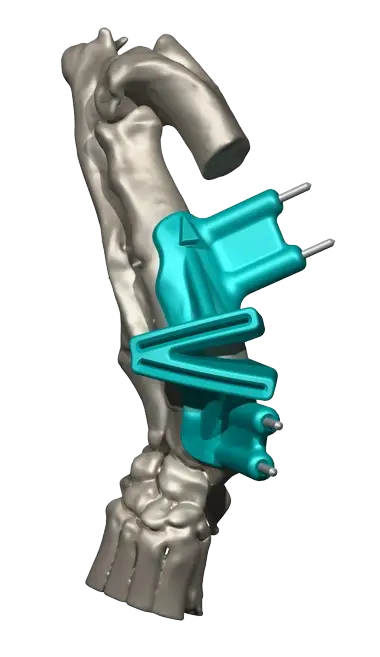
Corrective osteotomies of the lower limb are performed to correct bone deformities.
The aim of a realignment osteotomy is to restore the normal weight-bearing axis of the leg. To do this, the deformed bone is cut, corrected and usually osteosynthesised with plates.
Our osteotomy and fixation templates are made from biocompatible plastic using the 3D printing process (DLP); biocompatible templates are autoclavable, highly precise and minimally invasive due to the enormous time savings.
It goes without saying that our service also includes providing you with the corresponding bone pieces before and after the osteotomy for visualisation and planning purposes. On request, we can also offer you the plates and screws as a complete set.
bioengineering
Custom-made implants
Customised implants, here using the example of an ITAP.
Our implants are made from high-quality titanium (Ti6Al4V) using high-precision 3D printing technology. The design is based on industrial software that utilizes the patient’s previous CT scan. In addition, locking screws can be incorporated into the design and preoperative planning and supplied on request.
As an innovative and technologically advanced company, we can also offer plasma cleaning on request, our exoprostheses can be customised to the patient and their needs, using materials such as carbon to ensure maximum wearing comfort.


bioengineering
Anatomical 3D-bones
Our anatomical bones are used as illustrative models for preoperative planning or as training and functional models for training and further education. They are 3D-printed from non-autoclavable material (PLA) and have similar properties to original bones.
Bio3Dtech has a large database of original models and various requirement profiles, please contact us or visit our shop: https://shop.bio3dtech.com/.
rehabilitation
Orthotics & Prosthetics
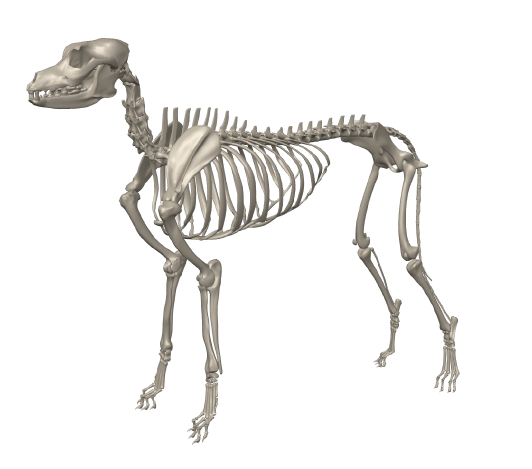
Select a highlighted region on the skeleton to explore our orthoses, prostheses and mobility aids for that part of the body.

rehabilitation
Orthotics
Orthoses are aids that support the function of the affected body part. Orthoses can be used to correct misalignments, support broken bones or relieve joints and muscles.
Orthoses are traditionally handmade by us. The impression and measurement forms, which we conveniently deliver to your home, serve as the basis. The orthosis is customised for each patient in many individual steps, which is the only way we can provide a lifelong guarantee.
We then conveniently send the finished aid to your home.
rehabilitation
Prosthetics
Prostheses are aids that are used to replace missing limbs. They are customised for each animal, provide optimum support and are designed to allow the animal to walk naturally.
Like orthoses, our prostheses are made by hand in the traditional way. The impression and measurement forms, which we conveniently deliver to your home, serve as the basis. The prosthesis is customised for each patient in many individual steps – this is the only way we can offer a lifelong guarantee.
We then conveniently send the finished aid to your home.


rehabilitation
Wheelchairs
bio3Dtech works with co-operation partners to provide animals in need with high-quality wheelchairs to improve their mobility and quality of life.
We have united for one goal: to provide the best service for your best friend.
Does your pet need a wheelchair? Then why not combine a wheelchair with our high-quality orthoses or supports to improve your pet’s mobility and physical condition.
online shop
NOW NEW!
In our shop, veterinarians will find everything they need to know about orthopaedic surgery.
The shop is currently under construction and will be successively expanded. Can’t find what you’re looking for? Contact us, we will be happy to help you.
FAQ
Frequently Asked Questions
Bio3Dtech combines veterinary medicine, engineering, professional CAD-based planning and advanced 3D printing to develop patient-specific solutions for complex orthopaedic procedures. Our core portfolio includes pre-operative planning, surgical guides, anatomical 3D models and customised implants.
From CT imaging to a patient-specific digital model and an approved surgical solution.
What is the starting point for every Bio3Dtech patient-specific case?
The basis of our patient-specific work is always a CT scan and the resulting DICOM data set. The DICOM data are converted and segmented to reconstruct the relevant anatomy as a precise digital 3D model. This model is then transferred into professional CAD software for further analysis, pre-operative planning and, where required, the design of surgical guides or patient-specific implants.
What information do you need in addition to the CT/DICOM data?
Alongside the DICOM data, we require information about the patient, the clinical problem and the surgeon’s intended procedure or treatment objective. Case-specific requirements are then discussed with the treating veterinary surgeon before the design process is finalised.
How does the Bio3Dtech workflow work?
A typical workflow is: CT scan and DICOM data → segmentation and 3D reconstruction → CAD-based analysis and pre-operative planning → collaboration with the veterinary surgeon → design of the required guide, model or implant → surgeon review and approval → manufacturing and quality control → delivery. For patient-specific implant projects, polymer prototypes and anatomical models can also be produced for verification before final manufacture.
How closely does Bio3Dtech work with the veterinary surgeon?
Close collaboration is an essential part of the workflow. Bio3Dtech’s engineering team develops the digital plan and patient-specific components in consultation with the treating surgeon. The surgeon reviews and approves the relevant planning and designs before the final solution is manufactured.
Transferring a CT-based surgical plan into practical patient-specific tools and physical anatomical models.
What is patient-specific pre-operative planning?
Pre-operative planning uses the individual patient’s CT-derived anatomy to analyse the surgical situation digitally before the procedure. Depending on the case, this may include anatomical and mechanical measurements, deformity analysis, osteotomy planning, implant positioning, drilling or screw trajectories, and simulation of the intended correction.
What are patient-specific surgical guides?
Patient-specific surgical guides are designed in CAD to fit defined anatomical surfaces of the individual patient. Depending on the procedure, they can support osteotomy positioning, drilling, K-wire placement, reduction, alignment or spinal stabilisation. Bio3Dtech offers guide solutions for applications including corrective osteotomies, spinal stabilisation, arthrodesis and transcondylar screw procedures.
What material are Bio3Dtech surgical guides made from?
Our surgical guides are 3D-printed from high-precision biocompatible resin. The guide material is suitable for steam sterilisation in an autoclave. Bio3Dtech specifies sterilisation at 121 °C / 250 °F or 134 °C / 273 °F for its guide systems. For selected product workflows, NextDent SG photopolymer is used.
Can Bio3Dtech help with limb deformity correction?
Yes. The CT-derived 3D anatomy can be used to analyse the deformity and calculate the intended correction. Patient-specific osteotomy, stabilisation or reduction guides can then be designed to help transfer the approved digital plan to surgery. Where appropriate, Bio3Dtech can also provide a customised titanium plate and matching screws as part of the solution.
Do you offer solutions for distal femoral osteotomy (DFO)?
Yes. Bio3Dtech can provide CT-based deformity analysis, pre-operative planning, patient-specific osteotomy guides and, where required, a customised plate for femoral deformity correction. The individual anatomical and mechanical angles can be analysed before the final correction is planned with the surgeon.
Do you provide anatomical 3D models?
Yes. Bio3Dtech offers a broad range of anatomical 3D models. They can be used for pre-operative visualisation and planning, education and training, practising fracture-treatment techniques and, depending on the model, pre-operative plate contouring. The Bio3Dtech shop currently includes individual bones, coloured bone models and movable joint models.
Can you create an anatomical model from an individual patient's CT scan?
Yes. In addition to standard anatomical models, patient-specific models can be produced from CT/DICOM data. These can reproduce the patient’s anatomy for pre-operative planning, visualisation, implant preparation or comparison with a planned corrected anatomy.
Can anatomical models be steam sterilised?
Standard anatomical models are generally produced from PLA and are not steam-autoclavable. Bio3Dtech states that these models can be disinfected with suitable alcohol-based products, but steam sterilisation can damage the material. Surgical guides are produced separately from biocompatible, steam-sterilisable resin.
Customised titanium implant solutions developed around the anatomy and surgical requirements of an individual patient.
What are patient-specific implants?
Patient-specific implants are designed around the individual CT-derived anatomy and the surgical plan. Bio3Dtech manufactures customised implants using medical-grade titanium alloy and high-precision 3D printing. Depending on the solution, locking screws can be incorporated into the implant concept and supplied with the case.
Which titanium material is used for customised implants?
For current patient-specific implant products described in the Bio3Dtech shop, final implants are manufactured by 3D printing from Ti6Al4V Grade 23 ELI titanium alloy. This material combines high strength, corrosion resistance and biocompatibility for implant applications.
Can Bio3Dtech support spinal procedures?
Yes. Bio3Dtech offers patient-specific planning and drill-guide solutions for spinal stabilisation. These can also be combined with the Bio3Dtech spinal stabilisation set, which includes screws in several diameters, rods, connectors, a torque-controlled screwdriver and the required instrumentation. The set can be purchased or rented.
What is a patient-specific Patellar Groove Replacement (PGR)?
A Patellar Groove Replacement (PGR) is a specialised partial knee replacement used in veterinary orthopaedics for selected cases of patellar luxation and severe pathology of the femoral trochlear groove. Bio3Dtech designs patient-specific PGR implants from CT data, taking the individual anatomy and biomechanical requirements of the patient into account. The final implant is manufactured in titanium alloy, with a polished groove surface designed to provide an appropriate tracking surface for the patella.
When is a PGR considered for patellar luxation cases?
Many patients referred to Bio3Dtech for a patient-specific PGR are complex patellar luxation cases in which conventional surgical options have already been exhausted, have failed previously, or are no longer considered suitable by the treating veterinary surgeon. The decision to use a PGR and the final treatment strategy remain the responsibility of the veterinary surgeon.
Does a PGR always require a femoral deformity correction?
No. A patient-specific PGR is a standalone implant solution and does not routinely require a femoral deformity correction. In selected patients, however, patellar luxation may coexist with a clinically relevant femoral deformity. If correction is part of the surgeon’s treatment plan, Bio3Dtech can combine the patient-specific PGR with deformity analysis, corrective planning, surgical guides and, where required, an additional customised implant.
What can Bio3Dtech provide for a PGR case?
Depending on the case, the workflow can include CT segmentation and anatomical analysis, CAD-based PGR design, patient-specific surgical guides, anatomical models and polymer prototypes for verification, followed by final manufacture of the patient-specific titanium PGR. Additional deformity-correction planning is included only where clinically required.
What other patient-specific implant solutions are available?
Bio3Dtech’s portfolio also includes customised solutions for bone deformity correction, joint reconstruction and other complex orthopaedic applications. The exact implant concept is developed case by case according to the patient’s anatomy and the surgical objective.
Patient-specific transcutaneous implant solutions and integration with Bio3Dtech’s wider planning and manufacturing workflow.
What is an ITAP?
An ITAP is an Intraosseous Transcutaneous Amputation Prosthesis: a patient-specific implant concept that creates a transcutaneous connection between the skeletal system and an external prosthetic component. Bio3Dtech offers ITAP solutions for dogs and cats, designed around the individual patient’s anatomy.
How is an ITAP case planned?
As with other patient-specific Bio3Dtech implants, planning starts from CT/DICOM data. The anatomy is segmented and reconstructed digitally, and the implant is designed in professional CAD software in collaboration with the treating veterinary surgeon. The final implant geometry, interface and fixation are developed according to the individual case.
Can Hydroxyapatite coating be incorporated into an implant solution?
Yes. Hydroxyapatite (HAp) coating can be incorporated into selected patient-specific implant solutions where it forms part of the agreed implant specification. Its use is assessed case by case within the overall implant and surgical planning strategy.
Are surgical guides and implants always supplied together?
No. Bio3Dtech solutions are modular and defined according to the individual procedure. A case may involve pre-operative planning, surgical guides, an anatomical model, a patient-specific implant, or a combination of these elements. The required scope is agreed with the treating surgeon.
How can veterinary surgeons explore previous Bio3Dtech cases?
Bio3Dtech’s interactive 3D dog skeleton is intended to organise clinical examples by anatomical region. By selecting a highlighted area, veterinary professionals can explore examples of pre-operative planning, surgical guides, patient-specific implants and other case-specific solutions.
?
Didn’t find your answer?
Tell us about your case, and our engineering team will be happy to discuss the best patient-specific solution.
Clinical responsibility. Bio3Dtech provides engineering, planning and patient-specific solutions to support veterinary professionals. Diagnosis, surgical indication, the final treatment strategy and intraoperative clinical decisions remain the responsibility of the treating veterinary surgeon.
news
Our News

Advanced Spinal Stabilisation Course
We are delighted to announce the Advanced Spinal Stabilisation Course, taking place in Cyprus on 8–9 November. This intensive 2-days specialized spinal surgery course is designed for veterinary surgeons seeking to enhance their skills and expertise using the latest implant stabilisation systems and state-of-the-art technology, such as patient-specific drill guides. The course is a combination…

EXCLUSIVE DISTRIBUTION IN EUROPE AND NORTH AMERICA
We are pleased to announce that Bio3Dtech will become the exclusive distributor of 3D Metal Tech. 3D Metal Tech already produces our titanium implants and supplies products of the highest quality using the latest technology. Bio3Dtech will offer the products in Europe and North America in addition to its own production. The 3D Metal Tech…

ECVS Annual Scientific Meeting 2025
We are proud to be attending the ECVS (European College of Veterinary Surgeons) Annual Scientific Meeting 2025 in Antwerp for the first time. Visit us at our booth no. 3 from 3 to 5 July in Antwerp, we look forward to your visit!